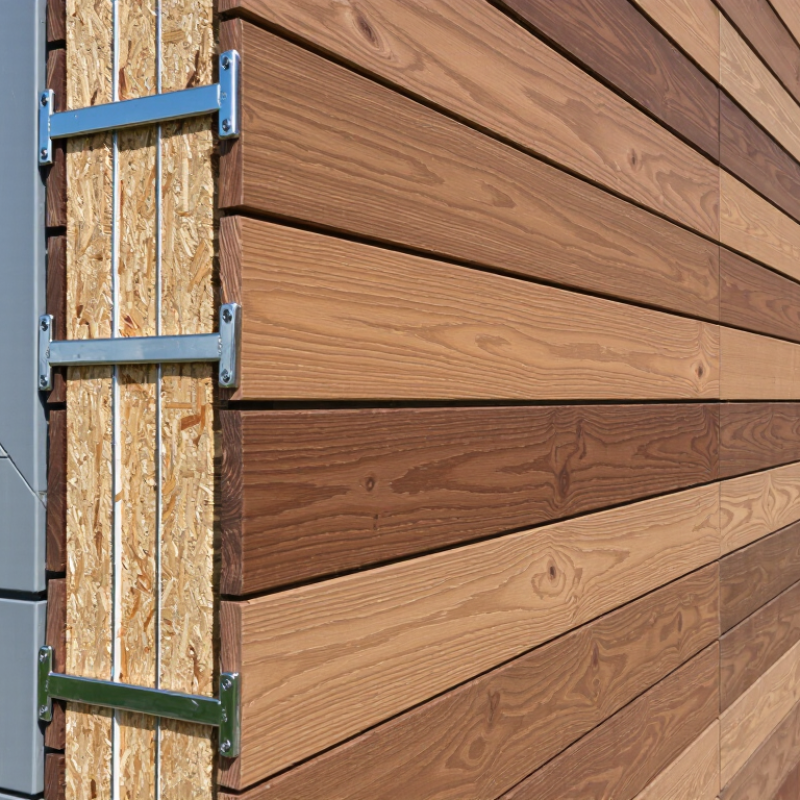
| Material Definition |
Wood-plastic composite cladding is an extruded material made from wood flour or fiber, a thermoplastic polymer such as HDPE, PVC, or PP, and additives. |
Explains why the product combines a wood-like appearance with improved moisture resistance and dimensional stability compared with untreated wood. |
Request the technical data sheet and declared polymer type before comparing products. |
| Typical Material Composition |
Wood content commonly falls within approximately 30%–60% by weight, with polymer, pigments, stabilizers, lubricants, and other additives making up the balance. |
The ratio affects surface appearance, water absorption, stiffness, processing behavior, and cost. |
Ask for a composition declaration or laboratory analysis; do not compare products by appearance alone. |
| Manufacturing Process |
Most profiles are produced by extrusion, followed by calibration, cooling, cutting, surface finishing, and optional co-extrusion or embossing. |
Controlled extrusion helps maintain consistent dimensions, profile geometry, and surface quality across production batches. |
Review production samples, dimensional tolerances, batch records, and quality-control procedures. |
| Common Profile Formats |
Typical formats include solid boards, hollow boards, slatted profiles, clipped panels, and tongue-and-groove systems. Common thicknesses are approximately 10–30 mm. |
Profile design influences weight, impact resistance, ventilation, fixing method, and installation speed. |
Check cross-sectional drawings, usable coverage, support spacing, and accessory compatibility. |
| Typical Density |
Approximately 0.90–1.40 g/cm³, depending on the polymer, wood-fiber content, fillers, and whether the profile is solid or hollow. |
Density affects panel weight, rigidity, screw-holding behavior, shipping cost, and subframe loading. |
Verify density using a representative sample and a documented test method. |
| Water Absorption |
WPC generally absorbs less water than untreated wood, but it is not completely waterproof. Reported values vary significantly by formulation and test duration. |
Lower absorption can reduce swelling, staining, and freeze-thaw damage, especially when edges and joints are properly detailed. |
Request water-absorption results tested to a recognized method such as ASTM D1037 or the applicable EN 15534 procedure. |
| Dimensional Movement |
Thermal expansion is commonly greater than that of natural wood. Linear expansion values depend on polymer type, profile geometry, color, and installation temperature. |
Expansion gaps are essential to prevent buckling, joint opening, or fastener stress. |
Use the supplier’s expansion coefficient and installation guide; calculate gaps for the local temperature range. |
| Mechanical Performance |
Flexural strength, modulus, and impact resistance vary widely between solid and hollow profiles and between different formulations. |
Higher stiffness and impact resistance are important for exposed façades, windy locations, and areas subject to accidental impact. |
Compare laboratory results using the same standard, specimen orientation, conditioning, and profile type. |
| Surface Finishes |
Common finishes include brushed, embossed, wood-grain, capped, co-extruded, and matte surfaces. Colors range from light natural wood tones to dark architectural shades. |
Surface technology affects color stability, scratch resistance, stain resistance, and visual consistency. |
Inspect outdoor-aged samples and request accelerated weathering data rather than relying only on color chips. |
| UV and Weather Resistance |
UV stabilizers, pigments, protective coatings, and co-extruded caps can reduce fading and surface degradation. No exterior polymer composite remains completely unchanged outdoors. |
Weather resistance determines long-term appearance and maintenance requirements. |
Ask for accelerated weathering results, color-change data, and the stated exterior-use warranty conditions. |
| Fire Performance |
WPC is combustible to some degree because it contains polymer and wood-based content. Fire classification depends on the complete product, profile, additives, and mounting system. |
Fire performance may determine whether the cladding is suitable for a particular building height or project type. |
Request a project-relevant test report, such as ASTM E84 or EN 13501-1, and confirm local building-code requirements. |
| Moisture and Fungal Resistance |
WPC is generally more resistant to rot and insect attack than untreated wood, but dirt accumulation, trapped moisture, and poor ventilation can still cause problems. |
Correct drainage and airflow are as important as the composite formulation for façade durability. |
Review installation details for rear ventilation, flashing, drainage paths, and clearance from standing water. |
| Installation System |
Typical systems use stainless-steel or corrosion-resistant clips and screws fixed to an aluminum, galvanized-steel, or treated timber subframe. |
A compatible concealed or face-fixing system controls alignment, expansion, wind resistance, and replacement access. |
Confirm clip spacing, fastener type, subframe spacing, edge distances, and maximum unsupported span. |
| Ventilated Façade Requirement |
Exterior WPC cladding is commonly installed as a rainscreen with a drainage and ventilation cavity behind the boards. |
Rear ventilation helps manage incidental moisture and reduces heat buildup behind the cladding. |
Check cavity depth, insect mesh, openings, flashings, and compliance with the project façade design. |
| Maintenance Profile |
Routine care usually consists of periodic cleaning with water and a mild detergent. Harsh solvents, abrasive tools, and unapproved coatings may damage the surface. |
Low routine maintenance is one of the main advantages over painted timber, although cleaning frequency depends on pollution and exposure. |
Obtain cleaning instructions and confirm the procedure for oil, grease, mold, and construction stains. |
| Environmental Documentation |
Some products use recycled wood fiber or recycled polymer, but recycled content varies by product and should not be assumed. |
Documented recycled content and product declarations support green-building and procurement requirements. |
Request recycled-content declarations, EPD information where available, and evidence of restricted-substance compliance. |
| Quality-Control Indicators |
Important controls include color consistency, profile dimensions, density, moisture content of wood flour, surface adhesion, mechanical properties, and packaging integrity. |
Consistent quality reduces installation waste, visible variation, and premature performance problems. |
Use pre-shipment inspection, approved reference samples, batch traceability, and independent testing for large projects. |
| Supplier Selection Criteria |
Key criteria include stable extrusion capacity, documented test data, tooling capability, custom profile support, reliable lead times, export packaging, and technical installation support. |
Manufacturing capability is more meaningful than catalog size when assessing a long-term exterior cladding supplier. |
Evaluate factory samples, production consistency, quality documents, sample approvals, and after-sales response procedures. |
 Haofa
Haofa