Gypsum Wallboard is a practical building material, but comparing its manufacturers takes more than counting plants or reading brand names. Board weight, edge quality, paper bonding, fire-rated assemblies, moisture resistance, and dependable delivery all shape performance on a real job site. USGS Mineral Commodity Summaries 2024 estimated U.S. gypsum mine production at about 22 million metric tons in 2023, with world production near 160 million metric tons. These figures describe gypsum supply, not finished wallboard output, so they should not be mistaken for a direct ranking of board makers. That distinction matters.
The Gypsum Association represents manufacturers and publishes technical resources on gypsum products and their uses. Its president and CEO, Stephen H. Meima, has emphasized gypsum board’s role in safe, durable building systems; that industry perspective points readers toward tested assembly performance, not marketing claims alone. Specifications still need careful checking. A familiar label cannot replace product data, installation guidance, or local availability.
This guide examines ten major manufacturers through their global reach, product portfolios, technical support, and reported sustainability efforts. Company scale and market presence can shift over time, and public disclosures vary by region. Treat the list as a comparison, not a universal verdict. A board that works well in a dry interior may not suit a humid room or a fire-rated wall. Small details count: a clean cut, an intact paper face, and panels arriving on schedule. The comparison that follows aims to make those differences easier to assess.
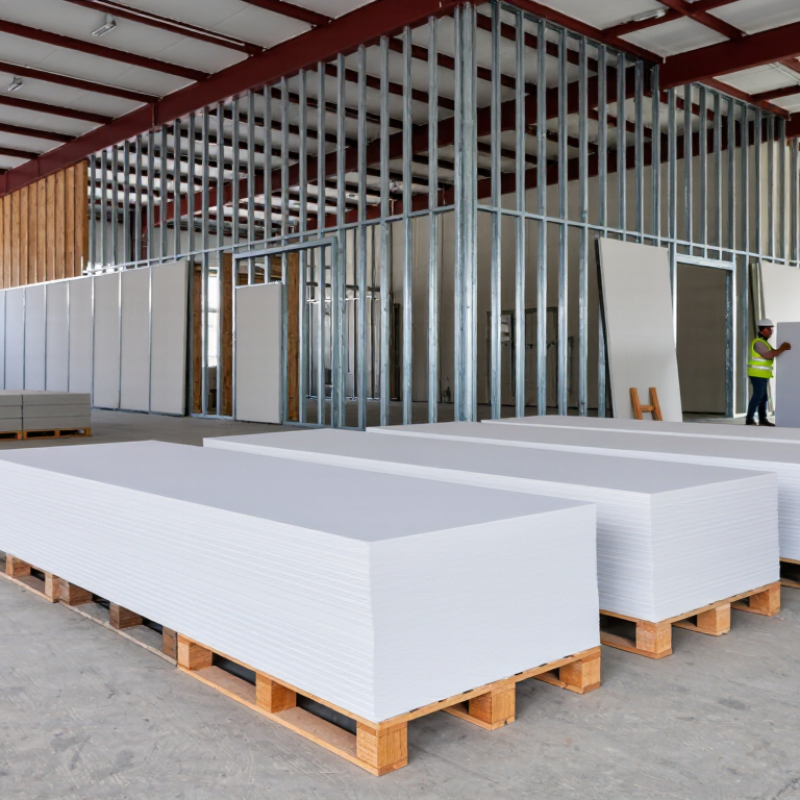
Gypsum wallboard is a factory-made panel with a gypsum core and paper or other facings. It creates interior partitions and ceilings, and it can also form rated assemblies when installed as part of a tested system. Common categories include regular board, Type X fire-resistant board, and water-resistant backing board. The right choice depends on exposure, framing, required fire performance, and the assembly details—not just the panel label. Water-resistant does not mean waterproof. That distinction gets missed.
ASTM C1396/C1396M sets requirements for gypsum board types, including dimensions and physical properties; it does not prescribe every installation detail. For installation guidance, ASTM C840 addresses application and finishing. The USGS Mineral Commodity Summaries 2024 estimated U.S. gypsum mine production at about 22 million metric tons in 2023, reflecting the scale of a material often hidden behind paint. Still, mined gypsum tonnage is not the same as finished wallboard output. On site, a clean cut edge, sound fastener spacing, and properly treated joints matter as much as the board designation. Specifications deserve a second look: a compliant panel alone cannot guarantee a compliant wall.
Global manufacturing scale in gypsum wallboard is not measured by plant capacity alone. A producer may operate large lines, yet ship less during maintenance or weak construction cycles. Reported capacity also varies by source: some figures describe nameplate output, while others reflect practical production. The distinction matters.
Regional production shapes delivery. Plants near dense building markets can reduce transport distance and protect supply during peak demand. Access to gypsum, energy, rail, and ports also affects operating costs. Shipment volumes reveal what reached customers, but they can shift with weather, inventory changes, and project timing. A ranking based on one year may therefore miss the wider picture.
Tips: Compare capacity and shipments separately. Check the reporting year and whether figures cover wallboard only. Look for regional plant locations, not just a global total. Treat estimates cautiously; public data is not always consistent.
A useful global comparison combines installed capacity, actual shipments, and the regions served. High output does not automatically mean dependable local availability. A distant plant may have impressive scale but face freight bottlenecks or long lead times. Conversely, a smaller regional network may respond faster to nearby demand. Scale is important, but it is not the whole story.
Country-level gypsum mine production is shown as an upstream indicator of regional manufacturing scale. It is not a measure of wallboard capacity or shipments.
Source: U.S. Geological Survey, Mineral Commodity Summaries 2024, Gypsum. 2023 figures are estimates; mine production is not equivalent to gypsum wallboard output.
A worldwide gypsum wallboard ranking should weigh annual capacity alongside geographic reach. Capacity indicates how much board a manufacturer can produce under stated operating conditions, but it does not guarantee steady output. Maintenance, product mix, and access to gypsum can affect actual supply. Regional plants also matter: shorter delivery routes can reduce transport costs and keep construction schedules moving.
Tips: Compare figures from the same year and check whether they describe installed capacity or actual production. Look for plants across multiple regions, not just a large global total. Ask whether facilities make standard and moisture-resistant board. Small details count.
Geographic reach is more than a map of factories. Warehouses, distribution partners, and nearby paper and energy supplies can shape how reliably products reach a project. A manufacturer with several regional sites may serve local builders more consistently than a distant producer with greater nameplate capacity. Still, public figures are not always reported in identical ways, so rankings can shift with the method used. Treat close positions with care. A transparent comparison should state its data year, explain its capacity measure, and distinguish confirmed information from estimates.
Data note: Comparable, audited annual wallboard capacity figures are not consistently published across manufacturers. To avoid presenting unsupported numbers, capacity is shown as a qualitative scale and exact figures are marked as not publicly disclosed. The anonymized ranking is indicative and reflects reported production scale and geographic reach; it is not an audited league table.
| Rank | Manufacturer | Annual wallboard capacity | Capacity scale | Geographic reach | Production footprint |
|---|---|---|---|---|---|
| 1 | Manufacturer A | Exact figure not publicly disclosed in a comparable format | Very large, multi-region producer | Global; operations across several major world regions | Multiple manufacturing sites serving local and export markets |
| 2 | Manufacturer B | Exact figure not publicly disclosed in a comparable format | Very large, multi-region producer | Global; broad presence across Europe and other major markets | Distributed plants supported by regional supply networks |
| 3 | Manufacturer C | Exact figure not publicly disclosed in a comparable format | Very large, multi-region producer | North America and multiple international markets | Large regional production base with cross-border distribution |
| 4 | Manufacturer D | Exact figure not publicly disclosed in a comparable format | Large, multi-country producer | Europe and selected markets beyond Europe | Several country-level production and distribution operations |
| 5 | Manufacturer E | Exact figure not publicly disclosed in a comparable format | Large regional producer | North America, with reach into neighboring export markets | Regional plants positioned near major construction markets |
| 6 | Manufacturer F | Exact figure not publicly disclosed in a comparable format | Large regional producer | Asia-Pacific and selected neighboring markets | Domestic production complemented by regional distribution |
| 7 | Manufacturer G | Exact figure not publicly disclosed in a comparable format | Large regional producer | Latin America and nearby markets | Country-based manufacturing footprint with regional sales reach |
| 8 | Manufacturer H | Exact figure not publicly disclosed in a comparable format | Mid-to-large regional producer | Middle East and adjacent markets | Regional plants serving domestic construction and export demand |
| 9 | Manufacturer I | Exact figure not publicly disclosed in a comparable format | Mid-to-large regional producer | Asia-Pacific, primarily through domestic and nearby markets | Concentrated production footprint with selective regional supply |
| 10 | Manufacturer J | Exact figure not publicly disclosed in a comparable format | Mid-to-large regional producer | Africa and selected neighboring markets | Smaller regional network relative to global multi-region producers |
A useful profile of a gypsum wallboard manufacturer goes beyond annual output. Ownership can show whether a company operates independently or within a wider building-products group. Plant networks matter too: nearby factories may shorten delivery routes and help serve regional projects. Still, factory counts alone do not prove reliable supply. Capacity, maintenance, and transport access deserve attention.
Tips: Compare plants by location, stated capacity, and distance to major markets. Check whether product specifications are available for each region. A shared brand portfolio can include standard boards, moisture-resistant panels, fire-rated products, and specialty systems, but availability varies by site. Ask for current technical sheets.
Product lines reveal how manufacturers serve different building needs. Profiles should distinguish core wallboard from panels designed for ceilings, sound control, or demanding interior conditions.
Ownership structures and brand portfolios can change, so dated information may mislead. A neat top-ten ranking can also hide differences in scale and local reach. That is worth questioning. Reliable comparisons identify their sources and explain what “top” means, rather than treating every company as directly equivalent.
A useful comparison of gypsum wallboard manufacturers starts with thickness, not a claim of universal superiority. ASTM C1396 covers several board categories, with commonly referenced thicknesses ranging from 6.4 to 25.4 mm. Intermediate options include 9.5, 12.7, 15.9, and 19.1 mm. Availability depends on board type and market, so a catalog listing should be checked against the relevant product data sheet.
Thickness affects handling, stiffness, and suitability for specific assemblies, but it does not establish fire, acoustic, or moisture performance by itself. A 12.7 mm panel may suit many standard interior walls; thicker boards may be specified where assembly design calls for greater mass or rigidity. Thin boards can help with curved surfaces, yet installation details matter. Small differences show up at joints.
For a practical benchmark, compare the stated thickness with the board’s intended use, edge profile, and installation requirements. Check the actual panel at delivery with a caliper or thickness gauge, especially when matching existing walls. Also confirm that the cited ASTM edition and board classification apply. Standards are useful, but they do not replace assembly testing or careful site judgment. A thickness chart alone can be misleading.
It is a factory-made panel with a gypsum core and paper or other facings. It is used for interior walls and ceilings.
Common types include regular board, fire-resistant Type X board, and water-resistant backing board. Choose based on exposure and assembly requirements.
No. Water-resistant does not mean waterproof. That distinction is easy to miss.
It sets requirements for gypsum board types, dimensions, and physical properties. It does not specify every installation detail.
ASTM C840 covers application and finishing guidance. A compliant panel alone cannot guarantee a compliant wall.
Clean cut edges, sound fastener spacing, and properly treated joints matter. Small details count.
No. U.S. gypsum mine production was estimated at about 22 million metric tons in 2023. That figure is not finished wallboard output.
Compare figures from the same year, and check whether they show installed capacity or actual production. Rankings can shift with the method used.
Maintenance, product mix, gypsum access, transport, and nearby plants can all matter. Factory counts alone prove little.
Look for ownership, plant locations, stated capacity, regional product availability, and current technical sheets. I may be oversimplifying; local supply still deserves a closer look.
This article explores Gypsum Wallboard, from its basic composition and common applications to the product categories covered by ASTM C1396. It explains how board types serve different building needs and how thickness, performance characteristics, and intended use shape product selection. The overview also places the industry in context by considering global manufacturing capacity, shipments, and the regional distribution of production.
A comparative ranking of ten leading manufacturers examines annual capacity and geographic reach, while company profiles describe ownership structures, plant networks, brands, and product lines without focusing on any one supplier. The article concludes with industry benchmarks for ASTM C1396 board thicknesses, spanning 6.4 to 25.4 mm, and explains how these dimensions help readers understand the range of products available across the worldwide market.